Euro
Euro
 USD
USD
 British Pound
 NULL
NULL





Product Description
PEO1 Antibody | 25-360 | ProSci
Host: Rabbit
Reactivity: Human, Mouse, Rat
Homology: N/A
Immunogen: Antibody produced in rabbits immunized with a synthetic peptide corresponding a region of human PEO1.
Research Area: Transcription, Homeostasis
Tested Application: E, WB
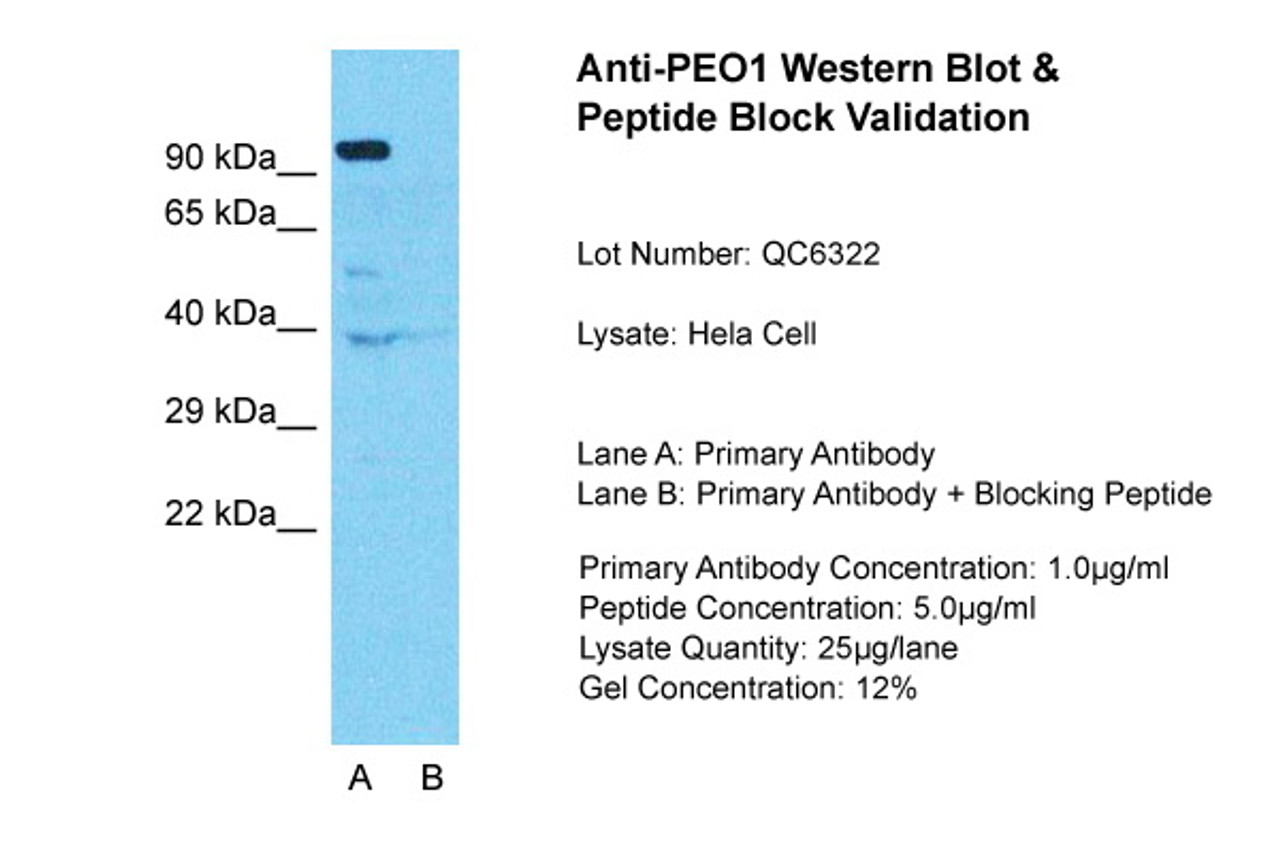
Application: PEO1 antibody can be used for detection of PEO1 by ELISA at 1:312500. PEO1 antibody can be used for detection of PEO1 by western blot at 1 μg/mL, and HRP conjugated secondary antibody should be diluted 1:50, 000 - 100, 000.
Specificiy: N/A
Positive Control 1: Cat. No. 1205 - Jurkat Cell Lysate
Positive Control 2: N/A
Positive Control 3: N/A
Positive Control 4: N/A
Positive Control 5: N/A
Positive Control 6: N/A
Molecular Weight: 77 kDa
Validation: N/A
Isoform: N/A
Purification: Antibody is purified by peptide affinity chromatography method.
Clonality: Polyclonal
Clone: N/A
Isotype: N/A
Conjugate: Unconjugated
Physical State: Liquid
Buffer: Purified antibody supplied in 1x PBS buffer with 0.09% (w/v) sodium azide and 2% sucrose.
Concentration: batch dependent
Storage Condition: For short periods of storage (days) store at 4˚C. For longer periods of storage, store PEO1 antibody at -20˚C. As with any antibody avoid repeat freeze-thaw cycles.
Alternate Name: PEO1, C10orf2, FLJ21832, PEO, PEOA3, SANDO, TWINL, PEO1, SCA8, ATXN8, IOSCA, MTDPS7
User Note: Optimal dilutions for each application to be determined by the researcher.
BACKGROUND: Twinkle is a mitochondrial protein with structural similarity to the phage T7 primase/helicase (GP4) and other hexameric ring helicases. The twinkle protein colocalizes with mtDNA in mitochondrial nucleoids, and its name derives from the unusual localization pattern reminiscent of twinkling stars.Twinkle is a mitochondrial protein with structural similarity to the phage T7 primase/helicase (GP4) and other hexameric ring helicases. The twinkle protein colocalizes with mtDNA in mitochondrial nucleoids, and its name derives from the unusual localization pattern reminiscent of twinkling stars (Spelbrink et al., 2001 [PubMed 11431692]) .