Euro
Euro
 USD
USD
 British Pound
 NULL
NULL



Product Description
JMJD2C Antibody | 25-106 | ProSci
Host: Rabbit
Reactivity: Human, Mouse
Homology: N/A
Immunogen: Antibody produced in rabbits immunized with a synthetic peptide corresponding a region of human JMJD2C.
Research Area: Transcription
Tested Application: E, WB
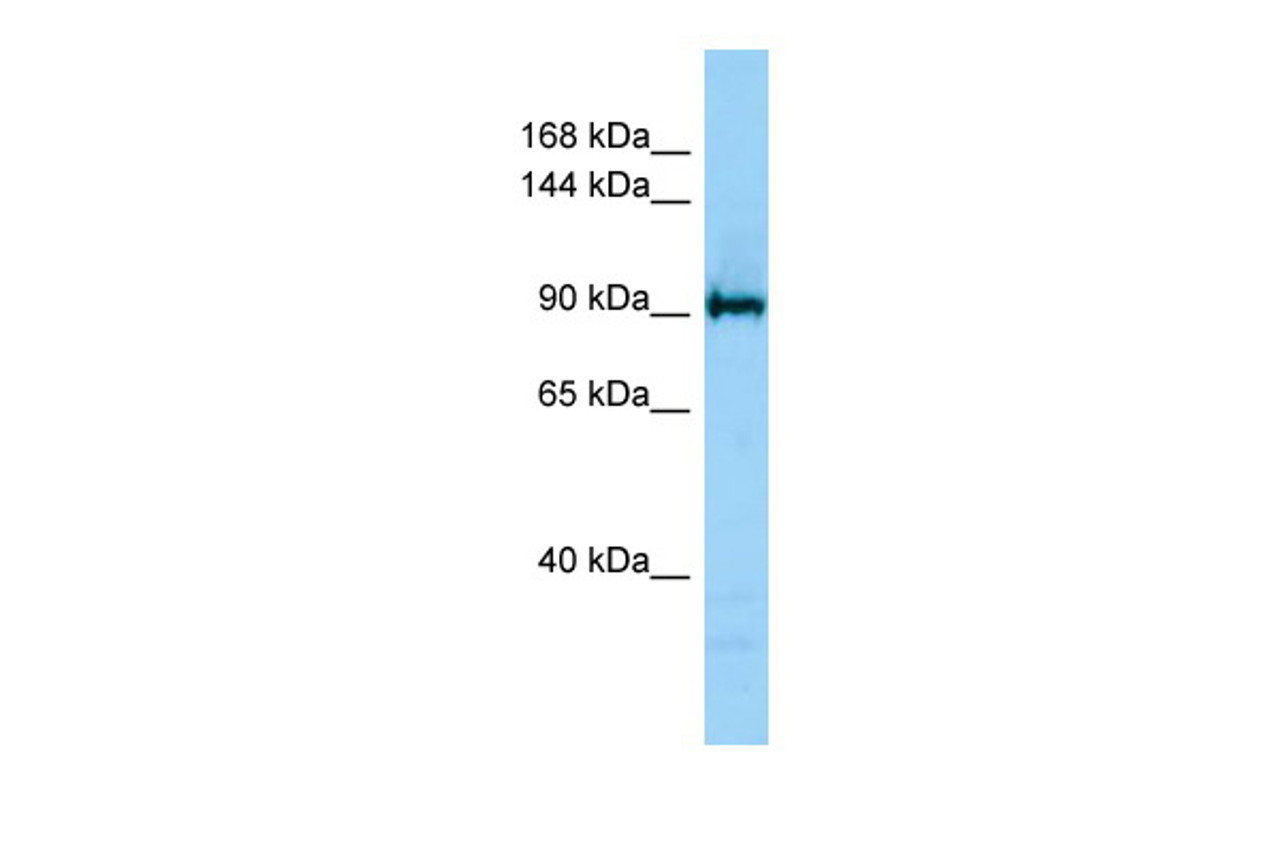
Application: JMJD2C antibody can be used for detection of JMJD2C by ELISA at 1:62500. JMJD2C antibody can be used for detection of JMJD2C by western blot at 1 μg/mL, and HRP conjugated secondary antibody should be diluted 1:50, 000 - 100, 000.
Specificiy: N/A
Positive Control 1: Cat. No. 1211 - HepG2 Cell Lysate
Positive Control 2: N/A
Positive Control 3: N/A
Positive Control 4: N/A
Positive Control 5: N/A
Positive Control 6: N/A
Molecular Weight: 120 kDa
Validation: N/A
Isoform: N/A
Purification: Antibody is purified by peptide affinity chromatography method.
Clonality: Polyclonal
Clone: N/A
Isotype: N/A
Conjugate: Unconjugated
Physical State: Liquid
Buffer: Purified antibody supplied in 1x PBS buffer with 0.09% (w/v) sodium azide and 2% sucrose.
Concentration: batch dependent
Storage Condition: For short periods of storage (days) store at 4˚C. For longer periods of storage, store JMJD2C antibody at -20˚C. As with any antibody avoid repeat freeze-thaw cycles.
Alternate Name: JMJD2C, FLJ25949, GASC1, JHDM3C, KDM4C, KIAA0780, bA146B14.1, JMJD2C, TDRD14C
User Note: Optimal dilutions for each application to be determined by the researcher.
BACKGROUND: JMJD2C is a member of the Jumonji domain 2 (JMJD2) family. It contains one JmjC domain, one JmjN domain, two PHD-type zinc fingers, and two Tudor domains. This nuclear protein functions as a trimethylation-specific demethylase, converting specific trimethylated histone residues to the dimethylated form. Chromosomal aberrations and increased transcriptional expression of this gene are associated with esophageal squamous cell carcinoma.This gene is a member of the Jumonji domain 2 (JMJD2) family and encodes a protein with one JmjC domain, one JmjN domain, two PHD-type zinc fingers, and two Tudor domains. This nuclear protein functions as a trimethylation-specific demethylase, converting specific trimethylated histone residues to the dimethylated form. Chromosomal aberrations and increased transcriptional expression of this gene are associated with esophageal squamous cell carcinoma.


![JMJD2C Antibody (C-term) [APR03565G]](https://cdn11.bigcommerce.com/s-452hpg8iuh/images/stencil/500x659/products/864128/1156195/logo__92149.1659788186__27780.1659860044.png?c=2 "JMJD2C Antibody (C-term) [APR03565G]")